Last updated: November 2, 2026
“Tell me about yourself” is the first question in almost every interview in Pakistan, from a bank trainee test to a government panel to a call-centre job. It sounds easy, but many candidates lose marks here because they either read out their CV or talk about their family for five minutes. This guide shows a simple four-step formula, five sample answers you can adapt, and the mistakes to avoid.
Why Interviewers Ask “Tell Me About Yourself”
The interviewer is not asking for your life story. In the first minute they want to know three things:
- Who you are in professional terms (your education, your field, your experience).
- Why you fit this job (your skills and what you have done).
- How you communicate (clear, calm and honest, or nervous and rambling).
It is also a warm-up. A good answer sets the tone for the whole interview, and the panel often picks follow-up questions from what you say. So say only what you can explain.
The 4-Step Formula for a Good Answer
Keep your answer between 45 and 60 seconds, which is about 120 to 150 words. Use four short parts:
- Present: who you are now. Your degree or current job.
- Past: one or two things you did that matter for this role. A project, an internship, a skill you built.
- Strengths: two skills that match the job advertisement.
- Future: why you want this job and what you hope to learn or contribute.
Before the interview, read the job advertisement again and pick the two or three words it repeats the most. Use the same words in your answer.
Sample Answer 1: Fresh Graduate (No Experience)
“My name is [Name]. I recently completed my BBA (Hons) from [University]. During my degree I did a final-year project on [topic] and a one-month internship at [company], where I helped with [task]. I am good at Excel and at working in a team, and I learn new things quickly. I am applying for this position because I want to start my career in [field], and I believe your training programme is the right place to learn.”
If you do not have an internship, replace it with a class project, a society role or a freelancing gig. Make sure it is true.
Sample Answer 2: Experienced Candidate
“I have three years of experience in [field]. In my last role at [company] I was responsible for [main duty], and I [one result, for example: reduced the monthly reporting time from two days to one]. My strengths are [skill 1] and [skill 2]. I am looking for a role with more responsibility, and this position matches the work I enjoy the most.”
Use a real number or result if you have one. If you do not have a number, describe the change clearly instead.
Sample Answer 3: Government Job Interview
Government panels in Pakistan, such as those for FPSC or provincial commissions, usually want a calm, short and respectful answer. Do not exaggerate. They often check your documents against what you say.
“Assalam o Alaikum. My name is [Name], and I am from [city/district]. I have completed my [degree] in [subject] from [university] with [marks/CGPA]. I have [experience, if any]. I am interested in this post because I want to serve in [department], and my education matches the requirements. I am hard-working and punctual, and I will follow the rules and learn from my seniors.”
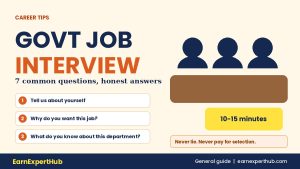
Read our guide on government job interview questions to prepare the next questions, such as “Why this department?” and “What do you know about this post?”.
Sample Answer 4: Career Change
“For the last four years I worked in [old field]. During that time I discovered that I enjoy [new area], so I completed [course/certificate] and built [small project]. I know I am new to this field, but I bring [transferable skill, for example: customer communication or reporting] from my earlier work. I would like to use these skills in this role.”
Sample Answer 5: Bank or Corporate Trainee Programme
“I am [Name], a [degree] graduate from [university] with a [CGPA]. I did [internship or project] and I enjoy working with numbers and people. I am comfortable with Excel and presentations, and I was a member of [society/team] where I learned to meet deadlines. I want to join your trainee programme because it gives structured training, and I would like to grow into a long-term role.”
If you are applying for a bank programme, check our guide to Allied Bank Trainee Officers 2026 for eligibility and the last date.
What to Say and What to Avoid
| Say this | Avoid this |
|---|---|
| Your degree, skills and one real achievement | Reading your CV line by line |
| Facts that match the job advertisement | Long family background or personal problems |
| A clear reason for choosing this job | “I need a job because of salary problems” |
| Calm and confident language | Memorised paragraphs that sound robotic |
| True information only | Claiming skills or experience you do not have |
How to Practise in One Evening
- Write your answer in 120 to 150 words using the four steps.
- Cut every sentence that does not help you get this job.
- Say it aloud with a timer on your phone. Aim for 45 to 60 seconds.
- Record yourself once, listen to it and fix the parts where you stop or speed up.
- Say it again in front of a friend. Do not learn it word by word. Learn the four points and speak naturally.
Speak in English if the interview is in English, and in Urdu if the panel asks you to. A simple answer in the language you are comfortable with is better than difficult English that you do not understand.
Useful Phrases to Open and Close Your Answer
You do not need fancy words. Short, clear phrases are enough. Here are some you can adapt:
- Opening (English): “Thank you for the opportunity. My name is [Name], and I am a [degree/job] from [place].”
- Opening (Urdu): “Assalam o Alaikum. Mera naam [Name] hai, aur main ne [degree] [university] se mukammal ki hai.”
- Linking your past to the job: “This experience taught me [skill], which I can use in this role.”
- Closing: “That is a short introduction. I would be happy to explain any part in more detail.”
The closing line gives the panel a clear signal that you have finished, and it invites them to ask questions about the parts they like.
Phone and Online Interviews
More companies now take the first round on a phone call or a video call. The answer is the same, but a few things change:
- Sit in a quiet room and check your internet and phone battery before the call.
- Keep your CV and the job advertisement in front of you, but do not read from them.
- Speak a little slower than normal, because the sound can be unclear.
- On a video call, look at the camera, not at your own face, and sit near a window or a light.
- If you do not hear a question, politely ask the interviewer to repeat it.
A Simple Template You Can Fill in Now
Copy this into a note on your phone and fill in the brackets in five minutes:
“I am [Name], a [degree / current role]. I [one key thing I did: project, internship, job task]. My strongest skills are [skill 1] and [skill 2]. I want this job because [one honest reason connected to the post].”
Then add one sentence that is true only for you, such as a small project, a course you finished, or a skill you taught yourself. That sentence makes your answer different from the hundred other candidates who say the same words.
Common Mistakes in This Answer
- Starting with “Sir, I am a very hard-working person.” Show it with an example instead of saying it.
- Talking for more than two minutes. The panel loses interest.
- No link to the job. Every sentence should connect to the post you apply for.
- Looking at the floor or your hands. Look at the panel, and smile once at the start.
- Lying about experience. Panels ask follow-up questions, and one wrong answer can cost you the seat.
Prepare the Rest of Your Interview
This answer is only the opening. Next, prepare the other common questions in our list of common interview questions and answers, and make sure your CV matches what you say. If you do not have a CV yet, follow our guide on how to write a CV with a free template. For private-sector jobs, also read salary negotiation for freshers and our tips for a LinkedIn profile.
Frequently Asked Questions
How long should my answer to “tell me about yourself” be?
About 45 to 60 seconds, or 120 to 150 words. Give the panel room to ask questions.
Should I memorise the answer?
No. Memorise the four points (present, past, strengths, future) and speak naturally. A memorised paragraph sounds fake, and you may forget a line and panic.
What should a fresher say if there is no experience?
Talk about your degree, a project, a society role, an internship, a short course or a freelancing task. Show what you learned, and say you are ready to learn more.
Should I mention my family?
One short sentence about where you are from is fine for a government interview. Do not talk about family problems or finances.
Can I answer in Urdu?
Yes, if the panel allows it. For private jobs, English is usually expected, so prepare both.
Final Words
A good “tell me about yourself” answer is short, true and connected to the job. Write it down, practise it aloud and keep the four steps in mind. For more guides on CVs, applications and interviews, visit our Career Tips page.
Get the latest jobs and government schemes every day. Join our WhatsApp channel.
Join Our Channel